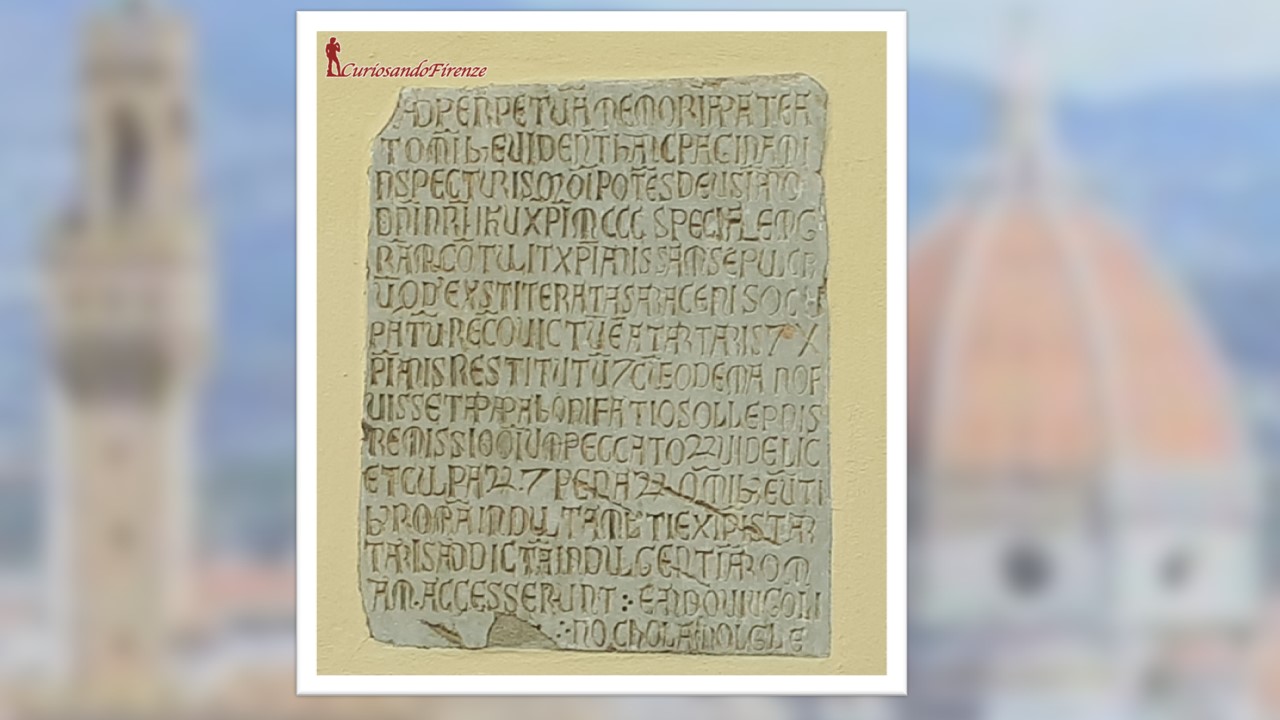
The anecdote of Ugolino, passed down through an unusual stone inscription, offers a fascinating and surprisingly personal glimpse into medieval Florentine life. The story focuses on a man, a certain Ugolino, who felt the need not only to undertake a significant spiritual journey but also to engrave it upon a marble plaque so that his devotion and travels would be known to posterity.
The historical context of this singular act of self-celebration is key: the year 1300, the first Jubilee Year in the history of the Church, declared by Pope Boniface VIII. This exceptional event promised the plenary remission of all sins to those who performed a pilgrimage to Rome and visited the designated basilicas. Thousands of pilgrims flocked to the “Urbe” (the City), and among them, with his inseparable companion, was our Ugolino.
The inscription, dating back to that very year of religious fervor, was located in what was then known as Via della Fogna (Sewer Street)—a name decidedly less grand than its current name, Via da Verrazzano. The text, written in Latin as was customary for official commemorations, was intended to celebrate Ugolino’s act of faith for all eternity.
However, it is in the final lines that the engraving abandons the rigor of Latin and the formality of stone to give way to a note of authentic and touching folk simplicity. Here, Ugolino breaks convention and, perhaps to ensure the message was unmistakable to everyone, concludes his account with a phrase in the vernacular (early Italian) that has since become famous:
… “E ANDOVVI UGOLINO CHO LA MOLGLE” (… “And Ugolino went there with his wife”)
This phrase testifies to the importance of that journey both as an individual religious undertaking and as a shared experience as a couple, sealing the plaque not only with faith but with love and partnership.
bye bye, Ugolino!