The historic center of Florence, the ancient Florentia, originated as a Roman city in the Arno Valley. The first settlements in the area date back to the Copper Age. Later, the Etruscans settled on the nearby hills and founded the city of Vipsul (known today as Fiesole).
The Etruscans also created a crossing point over the Arno to connect their territories. They chose the narrowest point of the river, where Ponte Vecchio stands today.
In 59 BC, Julius Caesar officially founded a colony for his veterans called Florentia. The name means “city that flourishes” and was intended as an omen of prosperity.

The city of Florentia was built following the model of the Castrum, a fortified military camp. Its layout was square and surrounded by walls, with four gates, one on each side.
Two main streets crossed the city and intersected perpendicularly: the Cardo (north-south) and the Decumanus (east-west). Today, these streets correspond to Via Roma and Via del Corso.
The meeting point of these two streets was the Forum, the center of civic life. Today, this location corresponds to Piazza della Repubblica. At the exact center of the square stands the Column of Abundance (Colonna dell’Abbondanza), which marks the ancient center of the city.
In the Middle Ages, Florence was the leading financial and commercial power in Europe. To demonstrate its strength, the city began minting its own currency in 1252: the Florin (Fiorino).
The gold Florin weighed 3.537 grams and was made of 24-karat gold. Its name derived from the symbol of the lily (the flower of Florence) engraved on the coin. Thanks to its high quality, it became the most important and widely used currency across the entire continent.
Later, in 1296, Florence also introduced the Popolino. This was a silver coin worth one-tenth ($1/10$) of the gold Florin.

The Marzocco is the symbol of Florence. It is a sculpture depicting a lion, a universal symbol of power and strength. For the Florentines, the Marzocco represented the authority and independence of the city.

The name derives from the Latin word Martocus, which means “little Mars.” Mars was, in fact, the ancient patron god of Florence.
In the 14th century, the connection with the lion was also physical: the city kept real lions in cages near Palazzo Vecchio. The presence of these animals in the city center served to demonstrate the grandeur and dominance of Florence.

Even today, the street where these animals were kept is called Via dei Leoni (Street of the Lions). This name serves as a reminder of the ancient custom of linking the heraldic symbol (the Marzocco) with the actual presence of lions.

The Lily of Florence is not just a decoration; it is a symbol of the city’s identity and independence.
Originally, the colors were the opposite of what we see today: a white lily on a red background. In 1251, after the “Guelphs” defeated their rivals, the “Ghibellines,” they decided to change the colors to mark a new era. The lily became red on a white background.
Even Napoleon Bonaparte tried to change it in 1811. He wanted a white lily on a blue background with three golden bees. However, the people of Florence protested so strongly that they ignored his rules and kept their red lily.
What makes it unique? Unlike other heraldic lilies (like the French one), the Florentine lily is “bocciolato” (budded). This means it has small buds between the main petals. If there are no buds, it is not the true Lily of Florence.
Today, this symbol is a legal treasure protected by the city. It represents a population that, for 800 years, has refused to lose its identity.
“Michelangelo chose to work on a massive block of Carrara marble that other artists had abandoned because it was considered flawed. Michelangelo altered several of the statue’s proportions: the head and hands are larger to symbolize intellect and strength. Conversely, the genitals are small, in keeping with the aesthetic canons of the time.
The statue depicts David at the moment of maximum tension, just before striking Goliath. For this reason, the David became a political symbol for Florence: a small city-state ready to defend itself against powerful enemies.
The statue weighs nearly six tons. Today, there are three Davids in Florence: the original is housed in the Galleria dell’Accademia, while two copies can be found in Piazza della Signoria and Piazzale Michelangelo.
There are also curious anecdotes surrounding this masterpiece. It is said that the patron, Soderini, felt the nose was too large. Michelangelo pretended to reshape it, letting marble dust fall to the ground to deceive him.
One copy of the statue was sent to London to Queen Victoria. To avoid scandalizing the Queen, a detachable bronze fig leaf was created to cover the statue’s genitals during her visits.”
The Vasari Corridor is an elevated enclosed passageway, approximately 1 km long, connecting Palazzo Vecchio to Palazzo Pitti.

Giorgio Vasari completed it in just five months in 1565, in time for the wedding of Francesco I de’ Medici.

Ferdinando I ordered the relocation of the butcher shops (beccai) from Ponte Vecchio because the smell disturbed the Medici as they passed through; they were replaced by the goldsmiths who still occupy the bridge today.

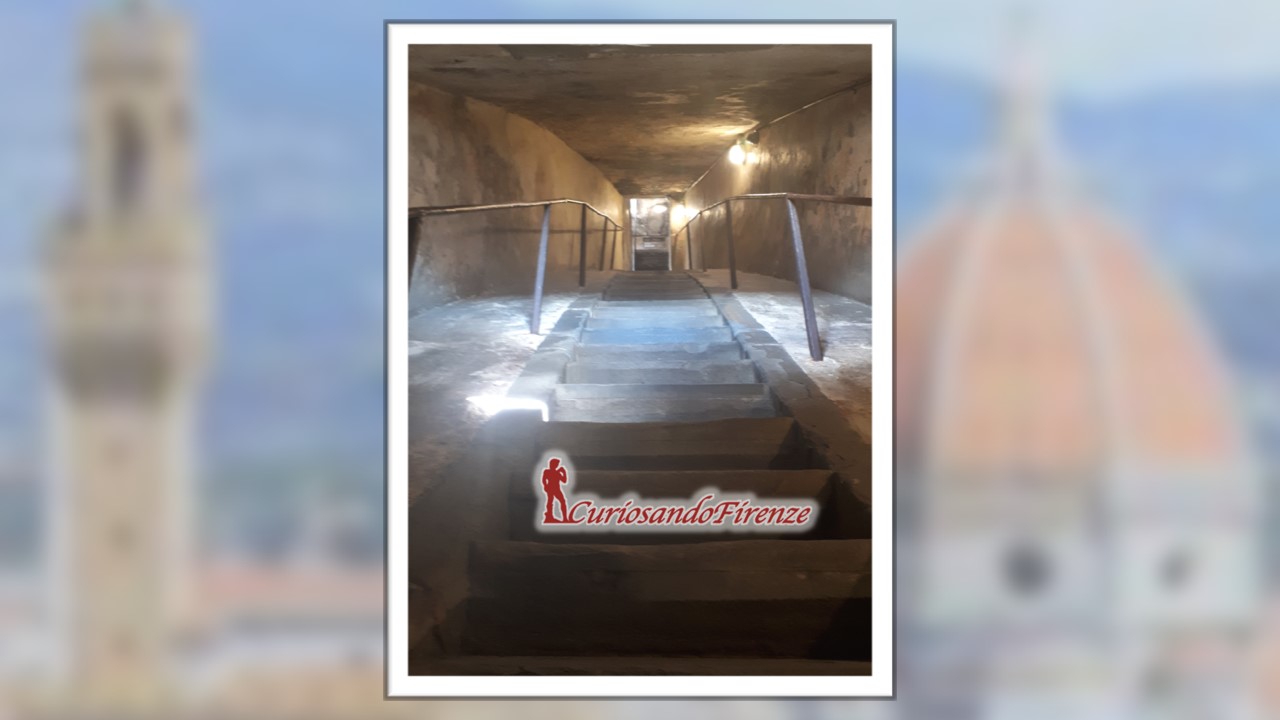
The corridor curves around the Mannelli Tower—whose internal walls can still be admired within the passage—because the family firmly opposed its demolition.

In 1938, Mussolini had the central windows overlooking Ponte Vecchio enlarged for Hitler’s visit.

It allowed the Grand Dukes to move freely without an escort and to attend Mass at the Church of Santa Felicita from a private balcony.

The exit is located to the left of the Buontalenti Grotto in the Boboli Gardens; the final short section of the corridor is not open to visitors.

In Piazza Santissima Annunziata, you will find Palazzo Budini-Gattai. If you look at the last window on the right of the top floor, you will notice that it is always open. Behind this peculiar detail lies a hidden legend.
Many centuries ago, a young noblewoman lived in that palace. Her husband had to leave for war, and she spent the rest of her life waiting for him, seated by that window. Every day, she gazed out at the square, hoping to see him return, but the man never came back.
Upon the woman’s death, her relatives tried to close the window. Immediately, strange events began to occur in the palace: furniture moved on its own and lights went out. Terrified, the family reopened the window, and the disturbances ceased at once.
Since that day, the window has remained open. It is said to be a way to allow the woman’s spirit to continue waiting for her beloved’s return.
In Piazza Santissima Annunziata, alongside the grand basilica, stand two magnificent works of art: the Fountains of the Sea Monsters (Fontane dei Mostri Marini). These bronze fountains are decorated with fantastical figures such as tritons, shells, and fish.
Their history is quite unique. In 1626, Grand Duke Ferdinand I de’ Medici commissioned the sculptor Pietro Tacca to create them. The original plan was to send them to Livorno to decorate the city’s harbor. However, after the Grand Duke’s death, his son Cosimo II decided to keep them in Florence.
The fountains were placed in the square symmetrically in relation to the Grand Duke’s statue, creating a perfect aesthetic balance.
Today, these sculptures are also famous by a curious nickname: “The Cacciucco Fountains.” The name was coined by the writer Piero Bargellini, who compared the variety of fish on the fountains to the typical fish stew of Livorno—the city they never managed to reach.
Brunelleschi‘s Dome, built between 1420 and 1436, is the largest masonry dome in the world. It represents the supreme achievement of Renaissance engineering.
The main challenge was to cover a span of over 42 meters at a tremendous height. At the time, it was impossible to build wooden scaffolding (centering) large enough to support the weight during construction.
Filippo Brunelleschi solved the problem with a stroke of genius: a self-supporting structure. To reduce weight and ensure stability, he designed a double shell. The dome consists of two layers: a thicker, more resistant inner shell and a thinner outer shell. These two shells are connected by masonry ribs that distribute the weight optimally.

The Herringbone Technique (Spina di Pesce): The innovative arrangement of four million bricks in this special sequence allowed each ring of masonry to support the one above it. This transformed the dome into a self-supporting structure that grew progressively stable as it was completed.

The Anecdote of the Egg
Filippo Brunelleschi is the protagonist of a famous story. To secure the commission for the Dome, he challenged other architects to make an egg stand upright on a marble slab. They all failed. Brunelleschi, however, lightly crushed the tip of the egg against the marble to flatten its base, and the egg remained standing. With this gesture, he demonstrated that the best solutions are often the simplest and most unexpected.
The Interior Fresco
Beyond its engineering, the Dome is renowned for its art. The interior is decorated with an enormous fresco of the Last Judgment (Il Giudizio Universale). The work was begun by Giorgio Vasari and completed by Federico Zuccari. The fresco covers approximately 3,600 square meters and features nearly 700 figures. It is one of the largest and most spectacular pictorial decorations in the world.

The Tuscan expression “fare il bischero” means to behave in a stupid or naive way. This phrase stems from a true story related to the construction of the Florence Cathedral (the Duomo).
The Bischeri were a very wealthy family who owned many houses in the area where the Cathedral stands today. When the Florentine government decided to build the Duomo, they offered the family a large sum of money (Fiorini ) to buy their land. However, the Bischeri were too greedy: they rejected the offer, hoping to extract even more money.
While the family was busy haggling over the price, a massive fire broke out and destroyed all their properties. In a single stroke, the Bischeri lost everything and were left penniless.
From that moment on, the name “Bischero” became a synonym for a foolish person who, through excessive greed, ends up losing everything. Even today in Florence, this word is used to tease anyone who behaves naively or recklessly.
.

The Mannelli Tower (Torre dei Mannelli) is a unique piece of Florentine history. In ancient times, there were four watchtowers at the corners of Ponte Vecchio; this is the only one that remains intact.
The tower is famous for a dispute that took place in the 16th century. Grand Duke Cosimo I de’ Medici wanted to build the Vasari Corridor, an elevated passageway to connect Palazzo Pitti to Palazzo Vecchio. The original project called for the corridor to pass directly through the tower.
However, the Mannelli family strongly opposed the plan and refused to allow their home to be demolished or altered. Defying the power of the Medici was very rare and dangerous, but the Mannelli family did not back down.
As a result, the architect Giorgio Vasari was forced to change his plans. Instead of passing through the tower, he built the corridor all the way around it, supporting it with large stone brackets. Even today, looking at Ponte Vecchio, you can clearly see how the corridor “embraces” the tower—a lasting testimony to the resistance of the Mannelli family.
In Piazza Santissima Annunziata, you can notice a suspended passage crossing Via Gino Capponi. This bridge connects the Basilica with the Palazzo della Crocetta, which today houses the National Archaeological Museum.
The passage was built for Princess Maria Maddalena de’ Medici, sister of Grand Duke Cosimo II. The princess had a severe physical disability and great difficulty walking. For this reason, the Grand Duke commissioned this private corridor.
The corridor allowed Maria Maddalena to go from her palace to the church without being seen by the public. In this way, she could participate in religious ceremonies privately, avoiding the curious stares of the crowd.
The path ended in a small room inside the church called the Coretto. From there, protected by a metal grate, the princess could look at the altar and listen to Mass in total peace. This structure is a perfect example of how architecture was used to meet the private and personal needs of the Medici family.
The Legend of Ginevra degli Amieri
Florence is rich in ghost stories. One of the most famous dates back to 1396 and concerns Ginevra degli Amieri. Ginevra was a beautiful young woman in love with Antonio Rondinelli, but her father forced her to marry another man: Francesco Agolanti.
Shortly after the wedding, Ginevra fell ill and was declared dead. She was buried in the Cathedral, but hers was not a real death; it was a case of apparent death (suspended animation). During the night, the woman woke up and, still dressed in her wedding gown, returned to her husband’s house. Francesco, believing she was a ghost, was terrified and drove her away. Even Ginevra’s parents did the same.
Desperate, Ginevra went to the home of her true love, Antonio. He recognized her, welcomed her, and cared for her. Later, the Church annulled the first marriage because it had been “interrupted by death” and because the husband had rejected her. Ginevra and Antonio were finally able to marry.
The street Ginevra walked that night is still called Via del Campanile today, but in ancient times it was known as “Via della Morta” (Street of the Dead Woman). It is said that every first Tuesday of the month, the ghost of a woman in a white dress still appears among the streets of the city center.
Florence holds a position of fundamental importance along the course of the Arno River. Unfortunately, this geographical location has exposed the city to a constant risk: it has been flooded multiple times, causing extensive and often catastrophic damage. These flood events have not only left deep wounds in the urban fabric but have also shaped the collective memory of the Florentine people.
Below are some of the most significant and devastating historical floods in Florence:
-
August 13, 1547: Although less known than others, this flood was still destructive. A plaque commemorating the event, when the river broke into the inhabited center, was placed in Via delle Casine.


-
November 3, 1844: In the 19th century, a new surge proved extremely damaging. The force of the water and mud overwhelmed streets and workshops; this flood was one of the most severe of the century, leaving a lasting mark on the collective memory before the definitive event of the 1900s. A plaque witnessing the catastrophe was placed in Via San Remigio.

-
November 4, 1966: This date is indelibly etched into the national consciousness. The 1966 flood is considered the most devastating of the modern era, an event that completely paralyzed Florence and caused incalculable damage to its global artistic heritage. The waters, thick with fuel oil and mud, reached unprecedented levels. The tragedy of ’66 was not just a natural disaster, but a global cultural emergency that mobilized thousands of “Mud Angels” (Angeli del Fango) from all over the world to save submerged masterpieces. (Commemorative plaques can be found scattered across many walls throughout the city).

These historical events serve as a constant reminder of the city’s fragility and the importance of its perennial struggle against the untamed force of the Arno River.
In Via della Ninna, on the right side of Palazzo Vecchio, there is a small secondary door. This opening has a history linked to a deeply hated figure: the Duke of Athens, Walter VI of Brienne.
In 1342, the Duke was called to govern Florence, but he quickly revealed himself to be a cruel tyrant. Knowing he was detested by the citizens and fearing an uprising, he decided to build a secret escape route inside the palace.
The Duke was right to be worried. After only ten months of rule, the Florentine people rebelled violently. On July 26, 1343, the citizens rose up to drive out the tyrant. Thanks to this hidden little door, the Duke managed to escape under the cover of night, avoiding the furious crowd and leaving the city forever. Even today, that door serves as a reminder of the inglorious end of his power.
Timeline of the Night of the Arno
It had been raining incessantly for two days. The Arno was high, but the Florentines were not overly concerned, as autumn swells were a common sight. However, that night, the unthinkable happened:
-
12:16 AM: Landslides and mudslips occur across half of Tuscany due to the rain (between 180 and 200 liters per square meter fell that night). The Arno overflows at Ponte a Poppi, flooding the town.
-
1:00 AM: The Arno overflows at La Lisca.
-
1:30 AM: Water begins to bubble up from the sewers in Piazza Mentana.
-
2:00 AM: The Mugnone stream bursts its banks and overflows near the Cascine Park.
-
2:30 AM: The Arno overflows at Nave a Rovezzano, Varlungo, and San Salvi.
-
3:30 AM: A fire department NCO, seeing water spurting from the river walls, calls headquarters to sound the alarm.
-
3:48 AM: The first ANSA news report: the situation in Tuscany is increasingly grave; Incisa Valdarno is submerged.
-
4:00 AM: The waters of the Arno invade Lungarno Cellini. Rushing through Via dei Renai, they submerge San Niccolò, Santo Spirito, San Frediano, Santa Croce, Isolotto, and San Bartolo a Cintoia.
-
4:30 AM: Badia a Settimo, San Colombano, and Lastra a Signa are flooded.
-
5:00 AM: The Arno overflows onto Lungarno Acciaioli and Lungarno alle Grazie. At San Piero a Ponti, the Bisenzio bursts its banks, flooding San Mauro a Signa and Campi Bisenzio. Montelupo is submerged by the Pesa river, which cannot flow into the swollen Arno.
-
6:50 AM: The embankment wall at Piazza Cavalleggeri gives way; the waters invade the National Library and the Santa Croce district.
-
7:00 AM: The printing house of La Nazione (then located in Piazza Santa Maria Maggiore) is submerged under 5 meters of water.
-
8:30 AM: The Ombrone bursts its banks at Castelletti; Lecore, Sant’Angelo a Lecore, Le Miccine, San Giorgio a Colonica, and parts of Prato are flooded.
-
9:00 AM: The waters flood Piazza del Duomo.
-
9:30 AM: In some areas of the city center, the water reaches the first floor of buildings.
-
2:30 PM: The waters flood the San Martino district in Campi.
-
8:00 PM: The Arno finally begins to recede slowly in Florence, while still affecting the Empoli area.
During the night between November 4th and 5th, the Arno flooded Castelfranco di Sotto, Santa Croce sull’Arno, and Pontedera. In Pisa, the Solferino Bridge collapsed.
The anecdote of Ugolino, passed down through an unusual stone inscription, offers a fascinating and surprisingly personal glimpse into medieval Florentine life. The story focuses on a man, a certain Ugolino, who felt the need not only to undertake a significant spiritual journey but also to engrave it upon a marble plaque so that his devotion and travels would be known to posterity.
The historical context of this singular act of self-celebration is key: the year 1300, the first Jubilee Year in the history of the Church, declared by Pope Boniface VIII. This exceptional event promised the plenary remission of all sins to those who performed a pilgrimage to Rome and visited the designated basilicas. Thousands of pilgrims flocked to the “Urbe” (the City), and among them, with his inseparable companion, was our Ugolino.
The inscription, dating back to that very year of religious fervor, was located in what was then known as Via della Fogna (Sewer Street)—a name decidedly less grand than its current name, Via da Verrazzano. The text, written in Latin as was customary for official commemorations, was intended to celebrate Ugolino’s act of faith for all eternity.
However, it is in the final lines that the engraving abandons the rigor of Latin and the formality of stone to give way to a note of authentic and touching folk simplicity. Here, Ugolino breaks convention and, perhaps to ensure the message was unmistakable to everyone, concludes his account with a phrase in the vernacular (early Italian) that has since become famous:
… “E ANDOVVI UGOLINO CHO LA MOLGLE” (… “And Ugolino went there with his wife”)
This phrase testifies to the importance of that journey both as an individual religious undertaking and as a shared experience as a couple, sealing the plaque not only with faith but with love and partnership.
bye bye, Ugolino!
On Palazzo Bartolini Salimbeni, in Via Antinori, a curious inscription can be read above the windows: “Per non dormire” (So as not to sleep). This was the motto of the Salimbeni family, and there are two different explanations behind these words.
Popular legend tells of a cunning plan. It is said that a member of the family wanted to purchase a precious shipment of goods before his competitors. The evening before the deal, he invited his rivals to dinner and slipped opium into their wine. The next morning, while his rivals were still fast asleep, he finalized the deal alone.
The historical version, on the other hand, suggests that the motto simply describes the Salimbeni family’s dedication to their work: they were so industrious that they “never slept” in order to stay ahead of the competition.
However, one mysterious detail remains: the family’s coat of arms features three poppies—the flowers from which opium is derived. Is it just a coincidence, or proof that the legend of the drugged wine is true? The doubt continues to fascinate Florentines to this day.

In Piazza Santissima Annunziata stands the Ospedale degli Innocenti (Hospital of the Innocents), Europe’s first orphanage, opened in 1445. Beneath its portico was the “Wheel” (La Ruota), a rotating wooden cylinder that allowed infants to be abandoned anonymously.
The mechanism was simple: a mother would place the baby in the outer part of the wheel and turn it toward the inside. A small bell would then alert the staff to the arrival of a newborn. Often, small objects or letters were left with the baby in the hope of being able to recognize and find them again in the future.
The children were called “Innocenti” or “Degl’Innocenti,” names that have since become very common last names in Florence. The institution welcomed thousands of children; in 1871 alone, more than 2,500 arrived.
The Wheel was officially closed in 1875. The last two children received were given symbolic names: Laudata Chiusuri (Praiseworthy Closing) and Ultimo Lasciati (Last Left). Today, the building houses a museum that tells this extraordinary story of charity and care.
In the 16th century, Florence was rife with conspiracies against the Medici family. One of the most famous was the attempted assassination of Duke Cosimo I, organized by the noble Pucci family.
The plan was very simple: the assassins would hide behind a ground-floor window of Palazzo Pucci. From there, they intended to shoot Cosimo I as he passed by in the street. However, the Duke was warned of the danger in time and managed to evade the ambush before it could be carried out.
Cosimo I’s revenge was terrible. Once the culprits were discovered, he had the mastermind, Pandolfo Pucci, arrested and publicly hanged. As a punishment and a warning for the future, the Duke ordered the window from which the attack was to be launched to be walled up forever.
Even today, anyone walking along Via de’ Pucci can see that bricked-up window. It remains a silent symbol of an ancient betrayal and the harsh justice of the Medici.
If you look at the base of Brunelleschi’s Dome (the drum), you will notice that only one of its eight sides is decorated with white and green marble. The other seven sides are bare, consisting only of exposed brickwork.
In the 1500s, the architect Baccio d’Agnolo was commissioned to finish this section with a decorated loggia. However, when the first side was completed, Michelangelo Buonarroti delivered a crushing verdict. After seeing the decoration, he dismissed it with contempt as a “cricket cage” (used during the cricket festival).
Michelangelo believed the design was too small and delicate for the immense scale of the Dome. Deeply offended by this ruthless critique, Baccio d’Agnolo abandoned the work. From that moment on, no one else dared to continue the project. Even today, the drum of the Dome remains unfinished, serving as a lasting testament to the immense power of Michelangelo’s opinion.
In Via Ricasoli, there lived a man named Anselmo, who was obsessed with a recurring nightmare: every night, he dreamed of being mauled by a lion. To Anselmo, the lion represented a real and inevitable threat.
One day, while passing by Porta di Balla, he saw two large marble lions ( Marzocco ). He thought that to overcome his fear once and for all, he had to defy the statues themselves. He approached one of the stone lions and, to prove his courage, thrust his hand deep into the sculpture’s wide-open jaws.
However, fate had a cruel sense of irony. A venomous scorpion had hidden inside the marble mouth. As soon as Anselmo reached in, the scorpion stung him. Between the shock and the venom, poor Anselmo died on the spot. His prophecy had come true in the most ironic way possible: he wasn’t killed by a real lion, but by his own superstition—and a tiny scorpion hidden in the stone.
The origin of the name of this famous Florentine square is linked to two very different legends.
The first version is connected to the presence of a well-known brothel. It is said that this establishment was frequented even by members of the Medici family. In this context, the term “Passera” (sparrow) stems from popular Florentine slang used to refer to female anatomy.
The second version, supported by the historian Piero Bargellini, is far more tragic. It is told that in 1348, during the Black Death, some children found a dying sparrow (passera) in the square. In an attempt to help the bird, the children became infected; the tiny creature was, in fact, a carrier of the plague. That single act of kindness marked the beginning of the devastating outbreak in Florence later described by Boccaccio.
The square is also immortalized in the folk song “Teresina” by Riccardo Marasco, a famous Florentine singer-songwriter.
The Ancient Pharmacy of San Marco is a cornerstone of the Florentine apothecary tradition, deeply connected to the Dominican Convent located at Via Cavour 146 R. Established by the Dominican friars—reportedly under the guidance of Saint Antoninus—the workshop originally served the internal needs of the religious community.
Its transition to a public pharmacy occurred in 1450, fueled by the financial and moral patronage of Cosimo de’ Medici (the Elder), who recognized its social and scientific significance. For centuries, it operated as a vital health institution alongside the historic pharmacy of Santa Maria Novella, remaining active until its closure in 1995.
The pharmacy was renowned for a diverse catalog of products, often advertised on marble signs outside the entrance. Key preparations included:
-
Alchermes: A famous crimson liqueur used for its tonic properties.
-
Anti-hysteric Water: A 18th-century remedy for nervous disorders.
-
Stomachic Elixirs & Tinctures: Aids for digestion.
-
Rose Water: A staple for hygiene and cosmetics.
-
Surgical Aids, Soaps, and Ointments: Essentials for daily medical care.
-
Oppiato da denti: An early ancestor of toothpaste and local anesthetics.
-
Bolivian Coca: An exotic ingredient showcasing the pharmacy’s global reach for medicinal substances.
Ultimately, the Pharmacy of San Marco exemplifies the crucial role Renaissance convents played as hubs for botanical and chemical research.
The Abbey of Santa Maria, universally known as the Badia Fiorentina, stands as one of the oldest and most significant religious monuments in Florence, serving as a true pillar of the city’s history. Its foundation dates back to the year 978, a period when the urban landscape of Florence was vastly different from today.
The complex was established by a prominent noblewoman of the era: Countess Willa of Tuscany. She was the mother of a figure who would become legendary among Florentines: Marquis Hugh of Tuscany (Ugo di Toscana).
Hugh, who inherited his mother’s passion for monastic life and philanthropy, was affectionately nicknamed the “Great Baron” (Gran Barone) by the people. This title was earned not merely through his lineage, but through his conduct; he distinguished himself as a generous benefactor, using his influence and wealth to protect the population and support religious institutions rather than for personal ostentation.
The memory of the “Great Baron” remains so deeply rooted in the Florentine collective identity that, nearly a thousand years later, the city still pays him tribute. Every year on December 21st—the anniversary of his death—a solemn Mass is celebrated in his memory at the Badia Fiorentina. This ceremony is not just a religious rite, but a living historical testimony of the affection and gratitude that Florence still holds for its ancient protector.
A solemn commemorative plaque in Piazza della Signoria marks the spot where, on May 23, 1498, Friar Girolamo Savonarola—alongside his brothers Domenico Buonvicini and Silvestro Maruffi—was hanged and burned following an “unjust sentence.”
Savonarola was a central and controversial figure of the Florentine Renaissance. A Dominican friar and influential preacher, he became famous for his fiery, apocalyptic sermons directed at the perceived corruption of the Church and the ruling elite. Opposed to the luxury and frivolity of Medicean Florence, he advocated for a radical moral and spiritual renewal of the city.
This crusade culminated in the infamous “Bonfires of the Vanities.” During these public events, items deemed sinful or vain—such as fine clothing, jewelry, cosmetics, mirrors, and even priceless works of art (including paintings by Sandro Botticelli) — were cast into the flames.
His radicalism and the establishment of a short-lived theocratic republic brought him into direct conflict with the Medici family and the Papacy. In 1497, he was excommunicated by Pope Alexander VI. By the following year, his political influence had collapsed; he was arrested, tried, and ultimately executed for heresy and sedition. The burning of his body in Piazza della Signoria marked the end of his fervent but brief moral reign over Florence.
On the northern side of Piazza Duomo lies a small, often overlooked detail: a stone plaque embedded in the pavement inscribed with “Il Sasso di Dante” (Dante’s Stone). According to local tradition, this marks the exact spot where Dante Alighieri used to sit, relaxing and contemplating the slow but inexorable construction of the Cathedral of Santa Maria del Fiore.
The legend says that one day, while Dante was deeply absorbed in thought, an acquaintance approached him to test his focus with a mundane question: — “Oh Dante, what is your favorite thing to eat?” Without looking up from the construction site, Dante concisely replied: — “L’ovo sodo!” (A hard-boiled egg).
The anecdote continues a full year later. The same man found the poet sitting on the exact same stone, once again lost in thought. Hoping to catch him off guard by picking up the conversation exactly where they had left off, the man simply asked: — “Co’ i’cche?” (With what?) Without a moment’s hesitation and showing incredible mnemonic recall, Dante replied as if not a single minute had passed: — “Co’ i’ sale!” (With salt).
This story remains a delightful example of Florentine wit and Dante’s legendary intellect, capable of maintaining absolute focus and memory even when faced with the most trivial of interruptions.
Ponte Vecchio, an invaluable symbol of the splendid city of Florence, boasts ancient origins. The first crossing in this stretch, originally made of wood, stood slightly further upstream than the current one, in the area now occupied by Piazza del Pesce.
Key Dates in the Bridge’s Turbulent History:
-
124 AD: During the expansion of the Via Cassia, Emperor Hadrian ordered the construction of a new structure called Ponte Marzio. This bridge featured solid masonry pillars topped by a wooden roadway. However, the force of the Arno river soon took its toll.
-
1177: A violent flood destroyed the bridge; it was subsequently rebuilt with three stone arches.
-
1218: The need for an additional crossing led to the construction of a second bridge further downstream, the Ponte alla Carraia, dubbed “Ponte Nuovo” (New Bridge). It was at this time that Ponte Marzio was officially renamed Ponte Vecchio (Old Bridge).
-
1322 and 1331: The bridge suffered significant damage due to fires.
-
1333: A catastrophic flood completely destroyed the structure. The reconstruction, vital for the city, was entrusted to Taddeo Gaddi.
-
1345: Gaddi completed the reconstruction of the bridge as we largely see it today.
-
1442: City authorities decreed that the shops on the bridge be occupied by the Beccai (butchers) to keep them away from the city center.
-
1565: A major structural change occurred with the creation of the Vasari Corridor by Giorgio Vasari—an elevated passageway running above the shops.
-
1593: The bridge’s purpose changed drastically when the butcher shops were replaced by goldsmiths, an iconic image that persists to this day.
-
1944: Ponte Vecchio is also known for an exceptional historical fact: it was the only bridge in Florence not blown up by retreating German troops during World War II.
 Il
Il
“On January 27, 1601, a violent lightning bolt struck the top of the Dome of Santa Maria del Fiore. The impact was so powerful that it caused the giant gilded copper sphere, created by Verrocchio, to plummet to the ground.
To commemorate this incredible event, a round white marble slab was placed on the exact spot where the ball fell. It can still be seen today on the pavement of the square, on the southeast side (near Via del Proconsolo).
Despite falling from a height of over 100 meters, the sphere was repaired in a short time. It was placed back in its position at the top of the Dome on October 21, 1602, where it remains to this day, watching over the city.”

The Legend of The “Berta“
“On the exterior wall of the Church of Santa Maria Maggiore, on Via de’ Cerretani, there is a marble woman’s head embedded in the masonry. Florentines call her ‘La Berta.’
There are two primary versions that attempt to explain the origin and meaning of this marble figure.
The First Version: The Curse of the Sorcerer The first, more dramatic version recounts an episode during the execution of Cecco d’Ascoli, the astronomer and poet burned at the stake for heresy and witchcraft. As he was being led to his death past the church, the condemned man desperately begged the crowd and the guards for a sip of water. At the time, there was a widespread folk superstition that if a sorcerer were hydrated before execution, they could miraculously survive the flames.
It was at this critical moment that La Berta, a woman presumably leaning out of a window or an opening in the church, shouted at the top of her lungs to the crowd and the executioners: “Do not give him water! If he drinks, he will not burn!”, effectively sealing the man’s fate. Feeling betrayed and desperate, Cecco d’Ascoli solemnly cursed her, saying: “And you shall never remove your head from there!” According to the legend, from that day forward, the woman’s head remained petrified on the wall as an eternal warning.
The Second Version: The Generous Greengrocer In the second version, Berta is identified as a “cavolaia” (a historical Florentine term for a greengrocer or vegetable vendor). It is said that this woman, having no direct heirs, decided to use her wealth for a public service. At her own expense, she had a bell installed on the church. Its tolling served as a signal for farmers in the fields, allowing them to hurry back so as not to ‘find themselves at the gates with the stones’—a local expression meaning to arrive just as the city gates were being bolted for the night. The marble head was thus placed on the wall in honor and memory of Berta’s generosity.
“Under the Loggia dei Lanzi, in Piazza della Signoria, stands one of Florence’s most famous statues: Perseus with the Head of Medusa, a bronze masterpiece by Benvenuto Cellini.
The work was commissioned by Grand Duke Cosimo I de’ Medici to send a clear political message. Perseus, severing the head of the monster Medusa, represents the Duke defeating the Florentine Republic to establish his absolute power. By raising the severed head, Cosimo declared to everyone that the republican era was over and that he was the new, sole leader of Florence.
However, the statue hides a secret. If you observe the sculpture from behind, you will notice a particular detail on the nape of Perseus’s neck, just behind the helmet. There, Cellini sculpted a human face: it is his hidden self-portrait.
Benvenuto Cellini was a man of difficult and rebellious character. By secretly inserting his own face behind the hero’s head, the artist wanted to leave an eternal and bold signature, silently defying the Medici power that paid him.”
The ‘Otto di Guardia e Balìa‘ were the ancient police force of Florence. Their task was very simple: to maintain public order and punish criminals with extreme severity.

These eight citizens held almost absolute power. In addition to arresting offenders, they issued laws to prevent crimes. To make these rules known to everyone, they had decrees (bandi) carved onto large stone plaques that were hung on the walls of buildings, especially at busy street corners.
These plaques forbade behaviors such as gambling, begging, or defacing walls. The punishments were incredibly harsh: very high fines, exile from the city, or even death.
A curious detail that can still be noticed today is that these inscriptions often contain grammar or spelling mistakes. This happened because the language used was the volgare (the vernacular spoken by the common people) rather than formal Latin. Today, these silent stones tell us just how harsh and severe life was in Renaissance Florence.”

“The Congregation of the Bonomini di San Martino is a charitable institution founded in Florence in 1441 by Saint Antonino Pierozzi. Its purpose was to help the ‘Poveri Vergognosi‘ (the Shameful Poor).
The ‘Shameful Poor’ were not common beggars, but rather people who had once been wealthy or well-to-do (such as merchants or artisans) and had lost everything, often due to exorbitant taxes. Out of dignity and honor, these individuals did not want to beg for alms in public. The Bonomini helped them in secret to protect their reputation.
When the Congregation ran out of money to provide aid, the friars would light a small candle (un lumicino) in the window of their headquarters. This served as a signal to the citizens: upon seeing the light, Florentines understood that the Bonomini needed help and would immediately bring offerings.
From this ancient custom comes the famous Italian saying ‘essere ridotti al lumicino‘ (to be reduced to the little light). Today, we use this phrase to describe someone who has almost run out of money or energy, just like the Bonomini when they lit that small candle to ask for help.”
“On the outer wall of Palazzo Vecchio, to the right of the main entrance, there is a small portrait carved into the stone. It is the profile of a man known as ‘L’Importuno di Michelangelo‘ (Michelangelo’s Nuisance). Legend has it that Michelangelo Buonarroti carved it in an incredible way: keeping his hands behind his back so as not to be discovered.
There are two popular explanations for this face:
-
The Boring Man: It is said that Michelangelo was often stopped in the square by a very tedious acquaintance who would waste his time with long complaints about his debts. One day, tired of listening to him, the artist allegedly carved the ‘bore’s’ face into the palace wall while pretending to listen, working with his chisel behind his back.
-
The Convicted Man: Another version suggests that Michelangelo saw a man being punished in the ‘pillory’ (alla gogna) in the square. Thinking that the punishment was too brief, the artist decided to carve the criminal’s face onto the wall so that Florentines would remember him and his crime for much longer.
In either case, this small detail tells us about Michelangelo’s rebellious character and his extraordinary speed in creating art, even in impossible situations.”
“The famous Neptune Fountain, a sculptural masterpiece created by Bartolomeo Ammannati between 1560 and 1565, is an undisputed symbol of Piazza della Signoria in Florence. Despite its grandeur and official function, Florentines affectionately know it as ‘I’ Biancone‘ (The Great White One), due to the stark white marble of the Neptune statue.

This monumental work was commissioned by Cosimo I de’ Medici, the Grand Duke who wished to provide Florence with its first public and celebratory fountain. For this purpose, a major competition was held, featuring the most talented sculptors of the time, including Benvenuto Cellini, Baccio Bandinelli, Vincenzo Danti, Bartolomeo Ammannati, and Giambologna.
In the end, Ammannati’s Neptune was chosen. The work was deemed the most appropriate to represent and exalt the glorious maritime and naval achievements of the Grand Duchy of Tuscany during those years. Neptune thus became an emblem of Medici power over the sea.
Finally, a historical detail near the fountain deserves attention: on the wall of Palazzo Vecchio, close to the basin, one can still read an inscription by ‘Li Signori Otto‘ (an ancient Florentine magistracy). It categorically forbids ‘filth of any kind’ (sporchezze di sorta alcuna) near the fountain, serving as a testament to the importance and decorum of the site since the time of its construction.”

“Saint Zanobi was one of the most beloved bishops in the history of Florence, known for his kindness and for the miracles he was said to perform.
His most famous miracle occurred after his death, during the translation of his body to the old cathedral (Santa Reparata). It was mid-winter when the funeral procession passed through the city center. It is said that the coffin accidentally touched a withered, dead tree along the road.
Immediately, despite the winter cold, the tree came back to life and began to bloom, covering itself in leaves and flowers. To commemorate this wonder, the Column of Saint Zenobius was erected on the exact spot where the tree once stood. Even today, the column can be admired in Piazza San Giovanni, right next to the Baptistery, serving as a symbol of the Saint’s protection over the city.”
“The construction of the Florence Cathedral, Santa Maria del Fiore, began on September 8, 1296. The initial design was created by Arnolfo di Cambio, but many other famous artists worked on the site over time, including Giotto, who designed the Bell Tower.
The pinnacle of its history was reached in 1436, when Filippo Brunelleschi completed the Dome. It was an incredible feat of engineering for the time. When it was finished, it was the largest church in the world; today, it remains the third largest globally.
Here are the primary dimensions of the Cathedral:
An important detail concerns the exterior: the colorful façade we see today is not ancient. It was only completed in 1887 by the architect Emilio De Fabris, who chose a style that would match the rest of the monuments in the square.”
“At the intersection of Via Vecchietti and Via Strozzi stands a small bronze statue known as ‘Il Diavolino‘ (The Little Devil). The work, which depicts a satyr holding a flag, was created by the famous sculptor Giambologna. The spot where it stands has been known for centuries as the ‘Canto del Diavolo‘ (The Devil’s Corner).
The statue commemorates a medieval legend from 1243. It is said that while Saint Peter Martyr was preaching to a crowd at this crossroad, the devil suddenly appeared in the form of a massive black horse. The animal began to charge furiously toward the people to terrify the faithful and interrupt the Saint’s prayer.
Saint Peter Martyr was not frightened: he raised his hand and made the sign of the cross toward the horse. Immediately, the power of evil was defeated, and the animal fled, vanishing into thin air. Centuries later, Giambologna created this sculpture to permanently mark the site of this miracle and to remind everyone of the Saint’s victory over the devil.”
“Under the Loggia del Mercato Nuovo (near the famous Porcellino statue), there is a white marble circle in the pavement. Today, it is a detail trodden upon by thousands of tourists, but in the past, it was the site of a humiliating punishment called the ‘acculata.’
In the Renaissance, Florence was the capital of commerce. If a merchant went bankrupt or failed to pay his debts, he was brought to this square for public punishment. Guards would pull down his trousers and strike his bare buttocks three times against this cold stone. It was a way to humiliate the merchant in front of the entire city; after this act, his reputation was destroyed forever.
From this ancient ritual come expressions that are still used in Italy today:
-
‘Essere con il culo per terra‘ (To have one’s bottom on the ground): It means to be in a disastrous financial situation or to have lost everything, just like the merchant punished on the stone.
-
‘Che sculo!’ or ‘Essere sculati’: Although today these terms are sometimes used to refer to luck, the original Florentine root indicates great misfortune. It refers to the ‘sculata‘ (the blow on the stone), a symbol of total failure.”
“In Piazza della Santissima Annunziata stands the equestrian statue of Ferdinand I de’ Medici. On the back of the bronze pedestal, there is a very curious detail: a swarm of bees sculpted in concentric circles.
The mystery of this sculpture is summed up in one question: ‘How many bees are there?’ Their arrangement is so intricate that it is almost impossible to count them accurately without getting confused. According to a popular legend, Florentine parents would bring their rowdy children here and promise them a gift only if they managed to find the exact number of bees, knowing full well they would never succeed.
Beyond the game, the bees hold a political meaning:
-
The Queen Bee: Represents Grand Duke Ferdinand I, a wise and peaceful sovereign.
-
The Swarm: Represents the people of Florence, hardworking and loyal to their Duke.
Although many say there are 91 bees (or about 73 according to other versions), the challenge remains open. To this day, tourists and locals alike spend long minutes in front of the statue trying to solve this ancient visual riddle.”
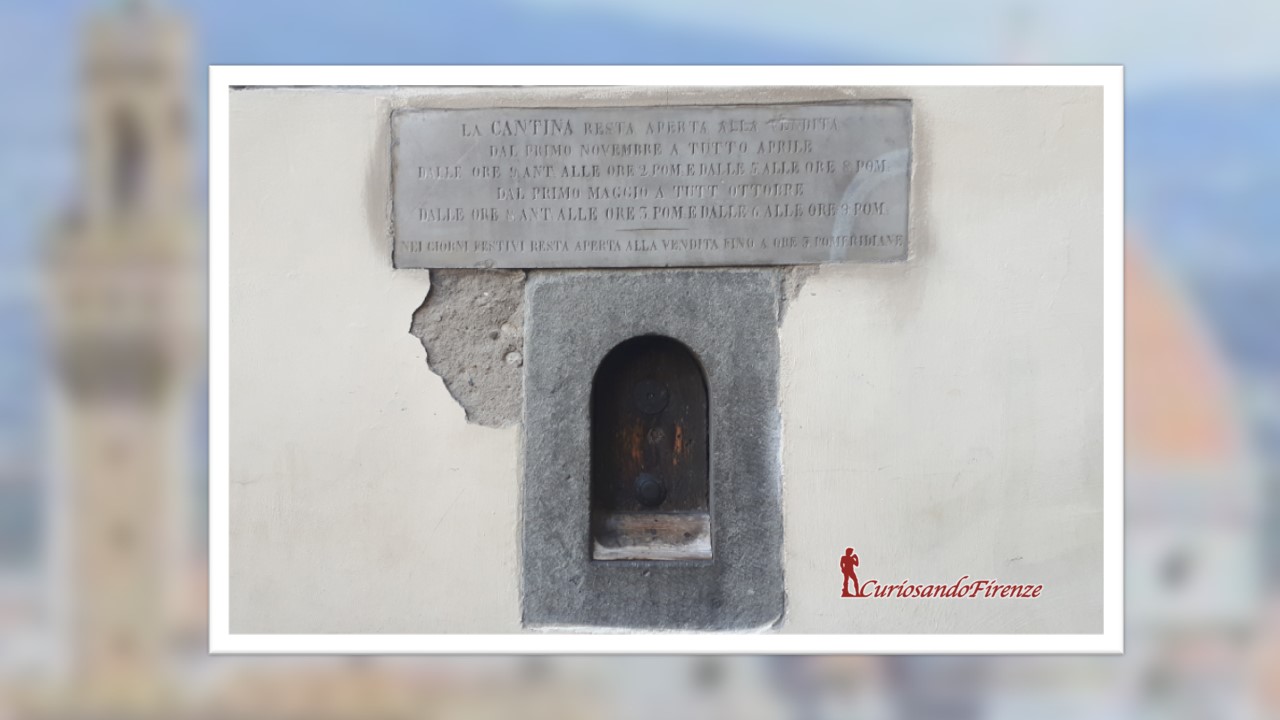
“As you walk through Florence, you may notice small arched openings on the façades of noble palaces: these are the buchette del vino (wine windows). These tiny stone windows had a very practical purpose: they were used to sell wine produced by noble families directly to the citizens.

The dimensions were specifically designed to allow only one fiasco (the typical Tuscan glass bottle) to pass through. Thanks to this system, palace owners could sell their surplus wine without opening a proper shop or going through taverns. A customer would knock, hand over their empty flask, and receive fresh wine directly from the palace cellar.

One of the most famous and best-preserved wine windows is located on Via delle Belle Donne. This example is special because it still features a plaque indicating the sales hours, much like a modern shop.

This direct sales system was simple and effective: it allowed the nobles to earn a profit and the common people to buy high-quality wine at a lower price. Today, these windows are protected as historical curiosities and symbols of the ingenuity of Florentine merchants.”

“Niccolò Grosso, nicknamed ‘Il Caparra,’ was the greatest blacksmith in the history of Florence between the 15th and 16th centuries. Even Giorgio Vasari wrote that no one had ever been as skilled as him in the craft of wrought iron.
His nickname comes from a specific business habit: he would never start a job unless he first received a down payment, known in Italian as a ‘caparra.’ This demonstrated just how confident he was in the quality of his work.
His most famous masterpiece can be found on the corners of Palazzo Strozzi: the imposing lanterns and wrought iron rings used for tethering horses or holding torches. These objects are considered true sculptures in their own right.
‘Il Caparra‘ was also famous for his honest and rebellious character. It is said that one day Lorenzo the Magnificent went to his workshop to ask for an urgent job. Niccolò, who was busy working for poorer clients, refused to give priority to the powerful ruler of Florence. He stated that the money of poor people had the same value as that of the Magnificent, proving that for him, ethics and respect for his customers came before power.”

“On the side of the Florence Cathedral facing Via Ricasoli, a bull’s (or ox’s) head can be seen carved high up on the wall. This curious detail has two main explanations:
-
A Tribute to Labor: According to the official history, the head is a gesture of thanks to the animals. For many years, oxen and bulls were used to transport the incredibly heavy blocks of marble needed to build the cathedral. Carving a bull’s head was a way to honor their sacrifice and strength.
-
The Cuckold’s Revenge: This popular legend is much more entertaining. It is said that a merchant living on that street was extremely jealous of his wife. However, the woman was having a secret affair with the master builder working on the Cathedral. When the husband discovered the betrayal, he reported the two lovers to the court. To get his revenge, the master builder carved the bull’s head with its horns pointed exactly toward the husband’s shop. In this way, every time the man looked out of his window, he was publicly mocked by the symbol of his betrayal (the term ‘cornuto’, or ‘horned,’ in Italy refers to someone whose partner has been unfaithful).”

The struggle between Guelphs and Ghibellines is one of the most chaotic and fascinating chapters of the Italian Middle Ages. It wasn’t just a war between soldiers, but a deep split that divided cities, neighborhoods, and even families.
1. The Origin: A Broken Promise
Legend says the conflict in Florence began in 1216 because of a broken engagement. Buondelmonte de’ Buondelmonti was supposed to marry a girl from the Amidei family to settle a peace treaty, but he left her for a woman from the Donati family. The offended Amidei killed him near the Ponte Vecchio. According to chronicles, this bloodbath gave birth to the rival factions.
2. Who were they and what did they want?
Simply put, the difference was about who should lead Italy:
-
Guelphs: Supported the Pope. They believed the Church’s authority should be higher than political power.
-
Ghibellines: Supported the Holy Roman Emperor. They wanted civil power to be independent from the Church.
3. Black Guelphs vs. White Guelphs
In Florence, things became even more complicated. After defeating the Ghibellines, the Guelphs started fighting among themselves:
-
Black Guelphs: Fully loyal to the Pope (Boniface VIII) and very radical.
-
White Guelphs: More moderate; they wanted to protect Florence’s independence. Dante Alighieri was a White Guelph. When the Blacks took power, he was exiled and never saw his city again.
4. Curiosity: Architecture as a Weapon
The rivalry changed the face of Italian cities:
-
Palazzo Vecchio: The building is asymmetrical because the city refused to build on land that once belonged to the Uberti (a powerful Ghibelline family). They preferred to leave the square wider rather than touch “enemy” soil.
-
Towers: Families competed to build the tallest tower. When a faction won, they would often “behead” (cut the top off) the rivals’ towers.
-
Battlements (Merli): You can still tell which side a castle was on by looking at the walls. Square battlements meant the castle was Guelph (Pro-Pope), while swallow-tail battlements (V-shaped) meant it was Ghibelline (Pro-Emperor).
“For centuries, Florence did not celebrate the start of the year on January 1st, but on March 25th. This date was chosen because it coincides with the Annunciation to Mary, a moment of immense religious significance for the city.
This tradition, known as the ‘Stile Fiorentino‘ (Florentine Style), lasted for a very long time. Even when the rest of the world adopted the Gregorian Calendar in 1582 (fixing New Year’s Day as January 1st), Florence proudly continued to use its own medieval system.
The final reform only arrived in 1750, when Grand Duke Francis Stephen of Lorraine mandated that all of Tuscany follow the January 1st date. A plaque commemorating this change can still be seen today inside the Loggia dei Lanzi in Piazza della Signoria.
Since the year 2000, Florence has officially resumed celebrating March 25th. Every year, a historical parade marches through the city center from the Palagio di Parte Guelfa to the Basilica of the Santissima Annunziata. In this way, citizens celebrate their ancient New Year, keeping alive the bond with the city’s history and devotion.”
The Historical Parade (Corteo Storico) is not just a show for tourists; it is a living symbol of Florence’s political identity. It honors the Siege of 1530, when the city bravely resisted the Imperial troops of Charles V.
The Heart of the Tradition: Calcio Storico The parade is deeply linked to Calcio Storico (historic football). On February 17, 1530, while the city was under attack, the people of Florence played a match in Piazza Santa Croce. This was an act of defiance to show the enemy that their spirit was not broken. Today, the parade continues to celebrate that courage.
Who Marches in the Parade? Every person in the parade represents a part of the old Republic:
-
The Gonfaloniere di Giustizia: The highest civil authority leading the group.
-
Musicians and the “Arti”: Representing the guilds (merchants and craftsmen) who were the economic heart of the city.
-
Soldiers (Armigeri): A reminder that the city’s freedom was protected by its own citizens.
-
The “Madonne”: Noble women who represent the grace and refinement of Renaissance society.
True to History What makes this parade special is its historical accuracy. The costumes are not just theater props; they are perfect replicas of 16th-century clothing made with high-quality fabrics like velvet and silk. When people march, they are literally “wearing history.”
A Symbol for Today During major city festivals, such as the Scoppio del Carro or St. John’s Day, the sound of the trumpets (chiarine) and drums reminds everyone that Florence is more than a museum. It is a community that still lives by the values of its ancient Republic.
Calling Calcio Storico a “sport” is not enough. It is the soul of Florence. It is a unique mix of wrestling, rugby, and boxing, acting as a bridge between the city’s glorious past and its modern identity.
The game started as Harpastum, a training exercise for Roman soldiers. However, its “Golden Age” was during the Renaissance. Back then, it was a game played by nobles and even future Popes (like Leo X), who competed in expensive, colorful clothes in Piazza Santa Croce.
The most legendary moment happened on February 17, 1530. Florence was under siege by the army of Charles V. To show the enemy that they were not afraid or starving, the Florentines organized a big match in the square. They even put musicians on the rooftops so the invaders could hear them. This act of “Florentine pride” is the reason the tournament is still played today.
In Calcio Storico, honor is more important than money. There are four teams representing the historic neighborhoods of Florence:
-
Azzurri (Blues) – Santa Croce
-
Bianchi (Whites) – Santo Spirito
-
Rossi (Reds) – Santa Maria Novella
-
Verdi (Greens) – San Giovanni
The rules, written in 1580, are strict. It is a game of endurance: if a player is injured or sent off, they cannot be replaced. You must fight with the strength you have left until the end. Traditionally, the winning team received a Chianina cow as a prize.
Every year, before the final on June 24 (the feast of St. John), a parade of over 500 people in Renaissance costumes (Corteo Storico) marches through the streets. With the sound of drums and the flag-throwers (Bandierai degli Uffizi), the atmosphere becomes electric and feels like stepping back in time.
The Bandierai degli Uffizi are the official flag-throwers of Florence. More than just performers, they are “ambassadors” of the city, representing the strength and elegance of the Renaissance.
In the Middle Ages, soldiers (called alfieri) practiced with flags to stay fit and to use them as signals on the battlefield. Over time, these military movements became a beautiful performance used during city celebrations.
The performance is not improvised; it requires intense athletic training and discipline. The flag-throwers perform specific historical movements with names like:
The Molinello: A spinning move.
The Onda (The Wave): Fluid, flowing motions.
The Salto del Fiocco: An athletic jump over the flag.
Passages: Throwing the flag under the leg, behind the neck, or around the waist.
Each flag represents the 16 Magistrature (the ancient government offices) of the 16th-century Florentine Republic. Today, the flags are divided into two groups of eight, keeping the visual history of the Renaissance alive through their bright colors and symbols.
The Bandierai travel all over the world to perform in famous squares. They carry the symbol of the Giglio (the Red Lily) everywhere they go. Their mission is to show that tradition is not a dead memory, but a “living fire” to be shared with pride.
“Every Easter Sunday, Florence celebrates the Scoppio del Carro. This ancient tradition combines a religious event with a firework display that is unique in the world.
The Event:
-
The Procession: Early in the morning, the large wooden cart called the Brindellone is pulled by oxen from its storage site to Piazza Duomo. The cart is accompanied by the Historical Parade in Renaissance costumes.
-
The Draw: In front of the Cathedral, before the show, a draw takes place to decide the matches for Calcio Storico Fiorentino, another symbol of the city.
-
The Flight of the Colombina: During the Mass in the Cathedral, the Archbishop lights a dove-shaped rocket (the Colombina). The dove speeds along a steel cable, exits the church, and strikes the cart in the square, igniting the fireworks.
-
The Omen: If the Colombina hits the cart and returns to the altar without a hitch, Florentines believe the year will be lucky and blessed with good harvests.
Historical Origins: The festival was born in 1099, during the First Crusade. A Florentine knight, Pazzino de’ Pazzi, was the first to scale the walls of Jerusalem. As a reward, he received three stones from the Holy Sepulchre. Upon his return to Florence, the stones were used to light the ‘holy fire’ to be gifted to the citizens. Over time, the distribution of this fire evolved into the pyrotechnic spectacle we see today.”
“At number 48 Via Il Prato, there is an exceptionally tall wooden door. Behind this massive entrance, one of the symbols of Florence is kept: the Brindellone.
In modern Florence, the word ‘brindellone‘ refers to a very tall person who is somewhat clumsy or wobbly when they walk. However, the origin of this name is ancient. Long ago, during the Feast of Saint John (June 24th), a cart full of hay would circle the city. On top of the cart sat a man dressed in skins, portraying the Saint. The man often swayed or staggered noticeably, and the Florentines jokingly began to call him ‘Brindellone.’
Over time, the name shifted from the man to the cart itself. Today, the only Brindellone remaining is the one used for the world-famous ceremony of the ‘Scoppio del Carro‘ (Explosion of the Cart) on Easter morning. It is a massive, ancient tower on wheels, pulled by oxen to Piazza Duomo, where it is ignited by fireworks to celebrate the holiday.”
“The Rificolona is a traditional festival held in Florence every year on September 7th, the eve of the Nativity of the Virgin Mary. The symbol of the festival is the ‘rificolona‘: colorful paper lanterns hung from long wooden poles.
On the evening of the feast, hundreds of children parade through the streets with these lanterns to Piazza Santissima Annunziata. A typical custom among Florentine youngsters is to try and hit the lanterns with blowguns (cerbottane) to poke holes in them or cause them to catch fire from the candles inside.
The origin of the festival: In the past, farmers from the countryside surrounding Florence would set out at night to reach the city in time for the market and religious celebrations. To light their path in the darkness, they used rudimentary lanterns.
When they arrived in the city, their poor appearance and clumsy lanterns made the young Florentines laugh. The citizens began calling these peasant women ‘fieruculone‘ (a play on ‘fair-goers’ and their physical appearance). Over time, this word evolved into ‘rificolona.’
Even the use of the blowgun comes from the past: young Florentines used to throw fruit peels and stones at the farmers’ lanterns to destroy them and mock them. Today, that old mockery has become a popular game that brings the city’s squares to life.”
“The Festa del Grillo (Cricket Festival) is an ancient Florentine tradition held in the Cascine Park on Ascension Day (during the spring).
For centuries, the main attraction was the sale of real, live crickets kept in tiny cages made of wood and wire. Those who bought a cricket did so as a ritual for good luck: the insect was meant to be released into the countryside as a symbol of freedom and prosperity.
The origins of the festival: There are two different explanations for this custom:
-
Symbol of Spring: The cricket, emerging from the earth after winter to sing, represented the awakening of nature and good fortune.
-
Crop Protection: Conversely, some historians believe the festival served to capture crickets in large numbers because they were considered harmful to agriculture.
The festival today: Since 1999, a law has prohibited the sale of live animals during the event. Today, the Festa del Grillo is an open-air market where the typical little cages can still be found, but they now contain toy crickets (made of plastic or ceramic). In this way, the festival continues to commemorate the ancient custom without harming the insects.”
The Black Death of 1348 was more than a medical disaster; it was a “history accelerator.” It killed about 60% of the population in Florence, forcing the survivors to completely reinvent their society.
The famous writer Giovanni Boccaccio used the plague as the setting for his masterpiece, the Decameron. In the story, ten young people flee to the hills to escape the disease. They try to build an “ideal society” through storytelling and art, choosing life and beauty over the horror of death in the city.

The plague even changed how people did business. The “Wine Windows“ (Buchette del Vino), which you can still see in the walls of Florentine palaces, were a clever invention for health safety. Noble families used these small openings to sell wine without touching the customers—a 14th-century version of social distancing.
While many fled, the Misericordia (a charitable organization) stayed to help. Members wore iconic black robes to remain anonymous while they transported the sick and buried the dead. This spirit of civic courage and solidarity is still a vital part of Florence’s identity today.
The plague caused a strange economic shift. Because so many people died, the remaining wealth was concentrated in fewer hands. The survivors felt a new, urgent need to celebrate life. This extra money and the desire for beauty provided the financial and cultural “spark” that eventually started the Renaissance.