
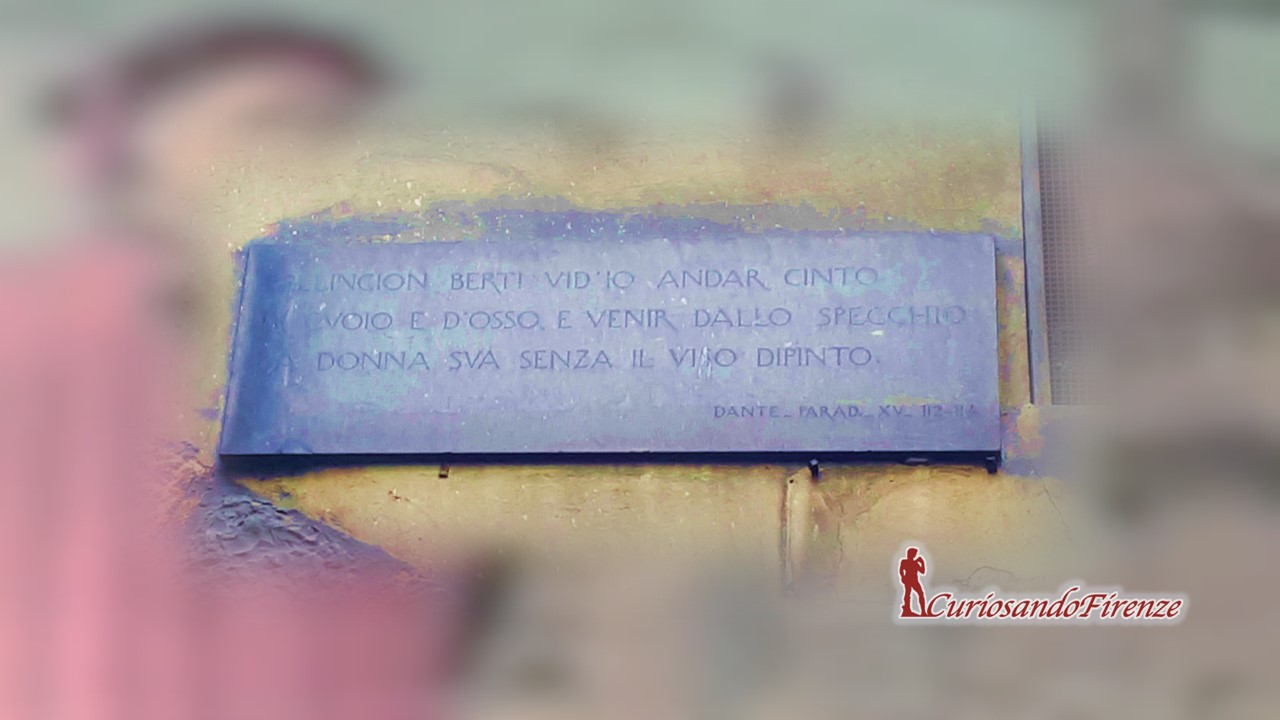
Plaque located in Via del Corso, near house numbers 1r and 3r.
Paradiso, Canto XV, vv. 112-114
” BELLINCIONI BERTI VID’IO ANDAR CINTO
DI CVOIO E D’OSSO, E VENIR DALLO SPECCHIO
LA DONNA SVA SANZA IL VISO DIPINTO.”
“I saw (in my time) Bellincion Berti (a man of high noble lineage) walking with a belt made simply of leather and bone, and I saw his wife turn away from her mirror without having painted her face (that is, without using makeup).”
“These three verses offer a vivid, concrete example of the sobriety and modesty that Cacciaguida had spoken of in general terms just before (vv. 97-99). To make his description more powerful, he cites two historical Florentine figures well known in Dante’s time:
-
Bellincion Berti: He was a high-ranking Florentine nobleman (father of the ‘good Gualdrada,’ a figure of virtue) who lived in the 12th century. Cacciaguida uses him as a symbol of the ancient nobility, which was modest and did not flaunt its wealth.
-
‘Girt with leather and bone’ (Cinto di cuoio e d’osso): His belt, a standard part of male attire, was simple and frugal, made of humble, functional materials (leather) or items of little value (bone). This stands in direct contrast to the rich belts adorned with gold and gems that were fashionable in Dante’s day.
-
His Lady (La Donna Sua): Referring to Bellincion Berti’s wife (or, by extension, the Florentine woman of that era).
-
‘Without a painted face’ (Sanza il viso dipinto): She would leave her mirror without having applied makeup (‘painted’ her face). This detail serves as proof of the feminine modesty and decency of the past. The woman of that time felt no need to alter her appearance with cosmetics, which Dante viewed as symbols of the vanity and superficiality he condemned in contemporary Florence.”


